
Technical data sheet for the Harris 80C286 microprocessor, covering clock rates, power, packages, pinout and memory features.
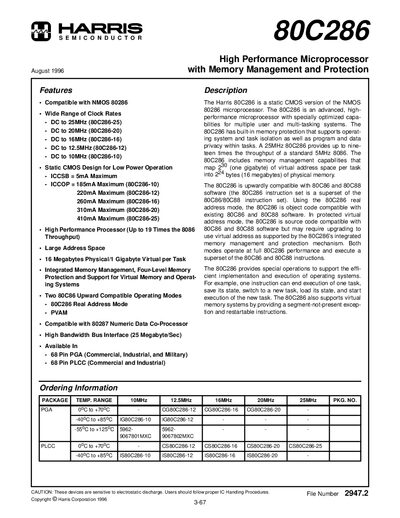
The Harris 80C286 is a static CMOS version of the NMOS 80286 microprocessor, offering high‑performance operation with built‑in memory management, four‑level protection and support for virtual memory. It runs from DC up to the specified maximum frequency and can be stopped for low‑power operation.
The document provides detailed pin descriptions, package options, electrical characteristics, register set, instruction set and flag definitions, making it a complete reference for designers integrating the 80C286 into commercial, industrial or military systems.
| Clock rate range | 0 – 25 MHz |
|---|---|
| Standby current (ICCSB) | 5 mA max |
| Package types | 68‑pin PGA, 68‑pin PLCC |
| Operating temperature range | -40 °C to +85 °C |
| Pin count | 68 pins |
| Physical address space | 16 MB |
| Virtual address space per task | 1 GB |
| Supply voltage | +5 V (VCC) |
The 80C286 can operate up to 25 MHz in the 80C286‑25 version.
The device is offered in a 68‑pin PGA package for commercial, industrial and military use, and a 68‑pin PLCC package for commercial and industrial use.
The standby (ICCSB) current is specified as a maximum of 5 mA.
It provides a physical address space of 16 megabytes per task.