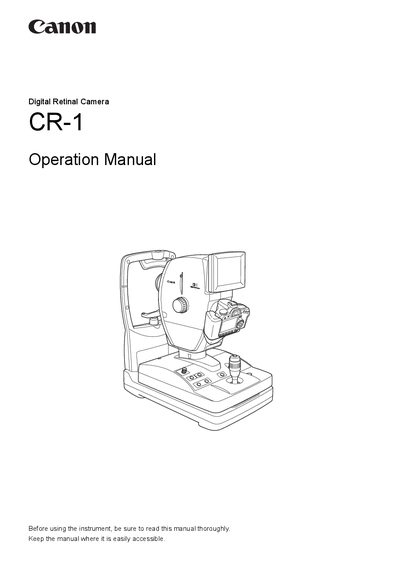
The Canon CR-1 Digital Retinal Camera Operation Manual provides safety guidelines, installation steps, specifications, and usage instructions.
About this manual
The Canon CR-1 is a non‑mydriatic digital retinal camera designed for ophthalmic imaging. It integrates a CCD sensor, an optional EOS digital camera, and a monitor for real‑time viewing.
This manual covers safety information, installation requirements, environmental conditions, main technical specifications, component descriptions, and service information to help users operate and maintain the instrument safely and effectively.
What's inside
- Safety Information
- Installation and Environment of Use
- Main Specifications
- Components
- Service Information
- Attaching and Removing the EOS Digital Camera
- Connecting the USB Cable
- Carrying the Instrument
Specifications
| Type | Non‑Mydriatic |
|---|
| Field angle | 45°/43° (digital) |
|---|
| Image size on sensor | ø13.7 mm |
|---|
| Diameter of pupil required | ø4 mm or more |
|---|
| Working distance | 35 mm |
|---|
| Patient diopter range | –10 to +15 D (no lens) |
|---|
| Flash intensity | 5.9 EV (Standard) |
|---|
| Monitor | 5.7‑inch LCD color monitor |
|---|
| Rated power supply | AC 100‑240 V, 50/60 Hz, 1‑0.4 A |
|---|
| Dimensions | 320 × 530 × 550 mm (W L H) |
|---|
| Mass | 21.5 kg (excluding EOS camera) |
|---|
Frequently asked questions
What safety precautions are required when using the Canon CR‑1?
Users must avoid flammable chemicals, keep the instrument away from water, ensure proper grounding, use an isolation transformer, and follow all warning and caution labels to prevent fire or electric shock.
What are the recommended operating temperature and humidity for the CR‑1?
The instrument should be used at temperatures between 10 °C and 35 °C with relative humidity of 30 % to 80 % (no condensation).
Which power supply voltages are supported by the CR‑1?
The CR‑1 accepts an AC power supply ranging from 100 V to 240 V, 50/60 Hz, with a current rating of 1 A to 0.4 A.