
CANcard2-CAR is a CAN interface designed for automotive electronics, used for configuring and validating CAN networks. It has powerful features and user-friendly testing tools, capable of handling and buffering data streams up to 1 Mbps without data loss. CANcard2-CAR provides access to two independent CAN networks and supports various programming tools and operating systems. It uses a universal CAN application interface, offering two programming models: CAN object memory and FIFO mode. The hardware interface of CANcard2-CAR includes two CAN channels, compatible with different CAN physical layers. It also integrates CAN transceivers through the connection cables, supporting both high-speed and low-speed CAN functionality.
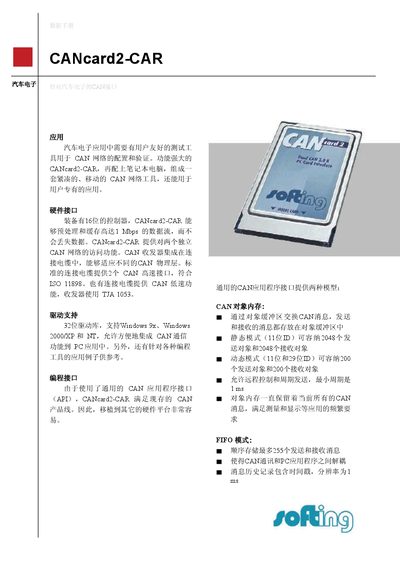
The CANcard2-CAR is a 16‑bit CAN interface card that connects to a PC via PCMCIA. It supports high‑speed (1 Mbps) and low‑speed CAN communication and includes drivers for Windows platforms. The handbook describes the hardware architecture, supported operating systems, and programming interfaces.
The document lists technical specifications such as controller type, memory size, CAN channel count, physical connectors, temperature range, and EMC compliance. It also provides information on the provided DLL/VxD/WDM drivers and contact details for Softing AG. This manual is written in Chinese.
| Controller | 16‑bit SABC16 |
|---|---|
| Memory | 256 KB RAM |
| PC Interface | PCMCIA V2.1 |
| CAN Channels | 2 channels, CAN 2.0A/B |
| High‑speed CAN Physical Interface | ISO 11898 compliant |
| Low‑speed CAN Physical Interface | TJA1033 compatible |
| Operating Temperature | 0 °C to 55 °C (operating), –25 °C to 70 °C (storage) |
| Supported OS | Windows 9x, Windows 2000/XP, Windows NT 4.0 |
| Drivers | 32‑bit DLL & VxD for Windows 9x; DLL & WDM for Windows 2000/XP; DLL & Kernel‑Mode for Windows NT |
| Standard Message Buffer (11‑bit ID) | 2048 transmit / 2048 receive messages |
| Extended Message Buffer (11‑/29‑bit ID) | 200 transmit / 200 receive messages |
The device supports Windows 9x, Windows 2000/XP, and Windows NT 4.0.
It provides two CAN channels that are compatible with CAN 2.0A and 2.0B.
The device operates from 0 °C to 55 °C and can be stored from –25 °C to 70 °C.