
CANusb is a powerful hardware interface perfect for use in accessing onboard CAN bus for various applications. It features easy-to-use Plug&Play functionality, making it particularly useful for mobile operations. In the ECU Engineering, Simulation, Test and Validation sectors, CANusb supports a wide range of communication applications, allowing parallel access to multiple ECUs on one CAN bus, which is particularly important for diagnostic and test applications. The standard CANusb design enables inexpensive access to CAN high-speed networks. CANusb-CAR is equipped with CAN high-speed and CAN low-speed transceivers for use with all kinds of ECUs. Transceiver switching is controlled by software, enabling simple and flexible use even with different applications.
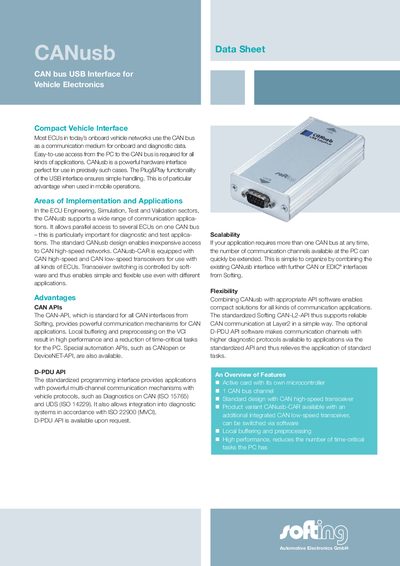
The Softing CANusb is a compact USB interface for CAN high‑speed (and optional low‑speed) vehicle networks. It provides plug‑and‑play connectivity, local buffering, and a range of APIs such as the standard CAN‑API and the optional D‑PDU API for diagnostic protocols.
The document includes technical data (dimensions, power consumption, microcontroller, memory, temperature range) and outlines product variants, system requirements, and ordering information, helping users integrate the device into ECU engineering, testing, and validation applications.
| Dimensions | 110 mm × 55 mm × 25 mm |
|---|---|
| Power supply | 5 V (via USB interface) |
| Current consumption | max. 310 mA |
| Microcontroller | Infineon C165 |
| Program/data memory | 256 kB Flash, 256 kB RAM |
| PC interface | USB 1.1, 12 Mbit/s |
| CAN bus channel | 1 channel (CAN‑high speed, optional low‑speed) |
| Operating temperature range | 0 °C … +55 °C (storage –25 °C … +85 °C) |
| Noise emission compliance | EN 55022, EN 65011 Class A |
It provides one CAN bus channel, with an optional low‑speed transceiver in the CANusb‑CAR variant.
The device is powered via the USB connector at 5 V and draws up to 310 mA.
It operates from 0 °C to +55 °C, with storage capability from –25 °C to +85 °C.