
CANcard2-CAR is a powerful hardware interface perfect for easy access to the CAN bus in the Engineering, Manufacturing, and Service environment. It is particularly suitable for ECU communication in mobile use.
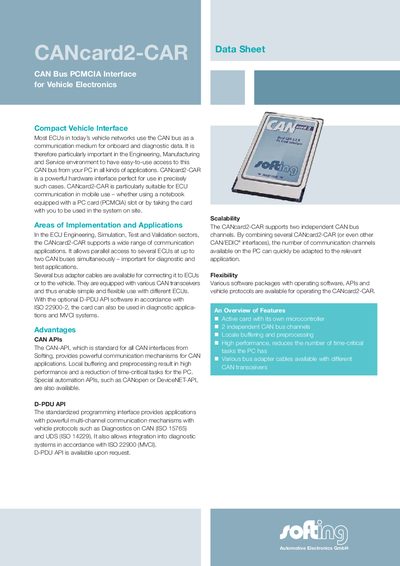
The CANcard2-CAR is a PCMCIA‑type CAN bus interface designed for vehicle electronics engineering, testing and diagnostic applications. It enables parallel access to up to two CAN buses, making it suitable for ECU communication in mobile or on‑site environments.
The manual describes the hardware features, such as an on‑board microcontroller, two independent CAN channels, and various bus‑adapter cables, as well as the software stack (CAN‑API, D‑PDU API) and system requirements for Windows operating systems.
| Format | PC Gard Type Il (PGMCIA) |
|---|---|
| Current consumption (typical) | 300 mA |
| Microcontroller | Infineon C165 |
| Vehicle interfaces | 2 × CAN (transceiver depends on cable) |
| CAN controller | SJA1000 |
| Operating temperature range | 0 °C … +55 °C (operation), -20 °C … +70 °C (storage) |
The device works with Windows 7, Windows Vista, and Windows XP.
It supports two independent CAN bus channels.
The card uses an Infineon C165 microcontroller.
Typical current consumption is 300 mA.