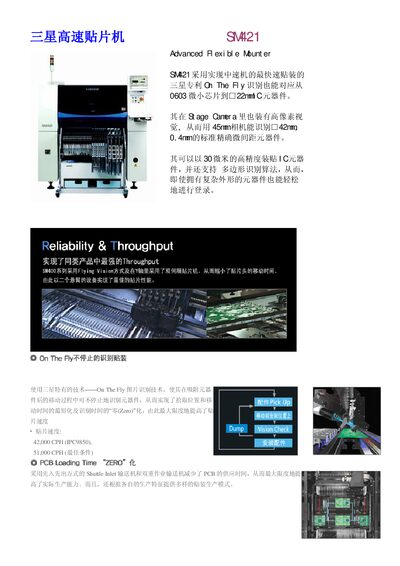
The Samsung SM421 Advanced Flexible Mounter manual provides operating instructions, setup, and maintenance details for this high‑speed pick‑and‑place machine.
About this manual
This manual describes the Samsung SM421 Advanced Flexible Mounter, a high‑speed pick‑and‑place machine that uses Samsung's patented On The Fly image‑recognition technology to place components ranging from 0603 chips to 22 mm ICs. It details the machine's dual‑servo Y‑axis, high‑precision camera system, and flexible feeding options, including IT feeding, non‑stop tape, and tray feeders.
The document also covers system performance (up to 51 000 CPH), precision specifications (±30‑50 µm), production capacity (11 700 CPH/m²), and maintenance procedures such as oil injection points, component‑shortage alerts, and automatic adjustment of pick‑up positions. This manual is written in Chinese.
What's inside
- Machine Overview
- On The Fly Recognition Technology
- Performance and Speed
- Precision and Accuracy
- Feeding Systems (IT, Tape, Tray)
- Dual‑track and Single‑track Placement
- Production Capacity
- Operator Interface and Alerts
- Maintenance and Service
Specifications
| Placement Speed | 42,000 CPH (IPC9850), 51,000 CPH (optimal) |
|---|
| Chip Placement Accuracy | ±50 µm (Cpk≥1.0) |
|---|
| IC Placement Accuracy | ±30 µm (Cpk≥1.0) |
|---|
| Absolute Accuracy | ±50 µm (Cpk≥1) |
|---|
| Production Capacity per Area | 11,700 CPH/m² |
|---|
| Dual‑track Placement Width | Up to 250 mm |
|---|
| Single‑track Placement Width | Up to 460 mm |
|---|
Frequently asked questions
What is the placement speed of the SM421?
The SM421 can place 42,000 components per hour (IPC9850) and up to 51,000 components per hour under optimal conditions.
How does the IT feeding system alert about component shortage?
The system monitors the remaining component quantity and generates an alert when the stock falls below a threshold, prompting the operator to replenish components.
What is Samsung's On The Fly technology?
On The Fly is an image‑recognition method that continuously identifies components while the pick‑up head moves, eliminating stop time and achieving zero recognition delay.