
This manual introduces the usage methods of L-1 and L-1A devices.
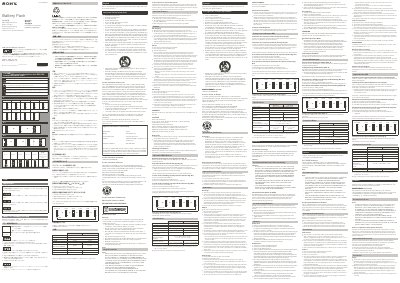
This document is the operating instructions for the Sony BP-U35 and BP-U70 battery packs, printed in multiple languages. It explains how to charge the packs, how the CHECK button and LEDs indicate remaining capacity during use and charging, and how the self-diagnosis function signals a battery at the end of its life.
The manual also covers safety precautions, conditions that trigger the protection circuit, long-term storage recommendations, disposal and recycling of lithium-ion batteries, transport notes stating the packs are under 100 Wh, and a specification table for both models. This manual is written in Japanese.
| Maximum voltage | DC 16.4 V |
|---|---|
| Nominal voltage | DC 14.4 V |
| Nominal capacity BP-U35 | 35 Wh |
| Nominal capacity BP-U70 | 72 Wh |
| Max discharge current BP-U35 | 5.5 A |
| Max discharge current BP-U70 | 6 A |
| Dimensions BP-U35 | 41.5 x 46.1 x 69.7 mm |
| Dimensions BP-U70 | 41.5 x 84.5 x 69.7 mm |
| Weight | approx. 235 g (BP-U35) / approx. 450 g (BP-U70) |
Yes. The BP-U35/U70 are under 100 Wh and are treated as equipment batteries that are not dangerous goods, but applicable transport regulations should be confirmed with each carrier.
If an abnormal load causes overcurrent or the output voltage falls below the discharge stop voltage of 11 V, the protection circuit cuts off the output. The protection circuit does not recover automatically once it has been triggered.
Store it with roughly 50% remaining capacity (two green LEDs lit) in a dry place, and recharge it back to about 50% about once every six months.
The self-diagnosis function makes the LEDs flash green when the usable time after a full charge becomes short. After charging, pressing the CHECK button lights all green LEDs only briefly on a degraded pack, indicating it should be replaced with a new one.