
This is an installation guide that explains how to install the VRF DX interface.
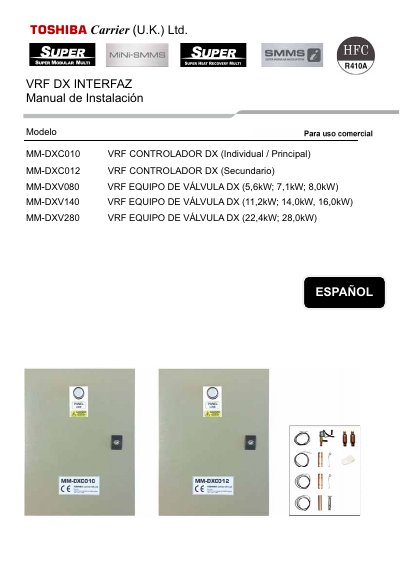
The Toshiba VRF DX Interface kit connects a third-party air handling unit with an R410A DX coil to a Toshiba VRF outdoor system (Mini-SMMS, SMMS, SMMS-i or SHRM). The kit consists of a DX controller and a DX valve unit in three sizes; the components are assembled on site, including brazing.
The manual covers the MM-DXC010 main/individual controller, MM-DXC012 secondary controller, and MM-DXV080/140/280 valve units. It explains supplied parts, safety precautions, piping and electrical installation, group configuration up to 48 HP, applicable controls, test operation, troubleshooting and service parts. This manual is written in Spanish.
| Maximum group capacity | 48 HP |
|---|---|
| Original controller maximum capacity | 10 HP |
| Refrigerant | R410A |
| Protection class | IP65 when wiring is correctly performed by a specialist according to local regulations |
| Diversity ratio | Maximum 110% when a DX interface is connected |
| Cooling air inlet temperature to DX coil | Minimum 15 °Cwb (18 °Cdb); maximum 24 °Cwb (32 °Cdb) |
| Heating air inlet temperature to DX coil | Minimum 15 °Cdb; maximum 28 °Cdb |
It connects a third-party air handling unit to Toshiba VRF systems including Mini-SMMS, SMMS, SMMS-i and SHRM.
Adding the MM-DXC012 secondary controller provides up to 48 HP by grouping one main controller and up to four secondary controllers.
No. The manual states that the DX controller must not be installed outdoors.
The air conditioner uses HFC refrigerant R410A instead of conventional R22.