
This document is an instruction manual for the IC-R20, which includes the product's features and characteristics.
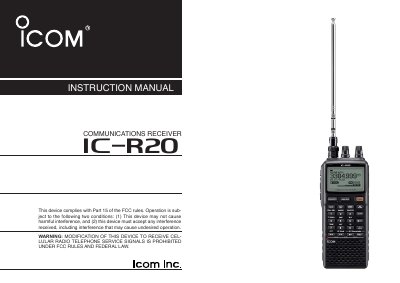
The Icom IC-R20 Communications Receiver is designed with superior technology to cover a wide frequency range of 0.150–3304.999 MHz. It features 1250 memory channels, dualwatch operation, and a built-in bar antenna. The device supports both external power supply and battery operation using the supplied BP-206 battery pack or alkaline batteries.
The manual provides detailed instructions on preparations, including battery installation and charging, as well as quick reference guides for antenna attachment and belt clip usage. It covers essential operating procedures such as frequency setting, audio volume adjustment, squelch level setting, and various scan operations including full, band, and programmed scans.
| Frequency Range | 0.150–3304.999 MHz |
|---|---|
| Memory Channels | 1250 |
| Auto Write Channels | 200 |
| Scan Edge Channels | 50 |
| Battery Charging Time | 8 hours |
| Operating Temperature | -10°C to +60°C |
The IC-R20 covers a wide frequency range from 0.150 MHz to 3304.999 MHz.
The receiver has 1250 memory channels with 26 banks available.
It takes 8 hours to charge the BP-206 battery pack.
No, you must never operate the receiver while driving a vehicle.