
The Icom IC-M412 VHF marine transceiver instruction manual covers operation, DSC, safety, maintenance, troubleshooting and specifications.
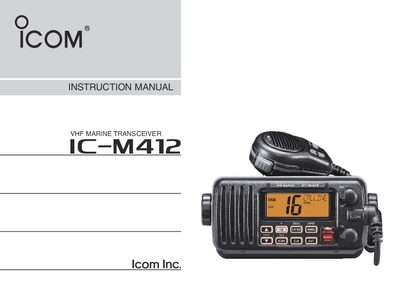
This manual provides detailed operating instructions for the Icom IC-M412 VHF marine transceiver, including operating rules, panel description, basic operation, scan and DSC functions, set‑mode programming, and connection/maintenance procedures. It also contains FCC compliance information, safety warnings, and a full list of specifications and optional accessories.
Safety and regulatory sections explain the required antenna gain and mounting height, FCC exposure limits, and proper handling to avoid damage. The troubleshooting guide helps resolve common issues, and the appendix includes a channel list and template for installation cut‑outs.
| Frequency coverage (Tx) | 156.025–157.425 MHz |
|---|---|
| Frequency coverage (Rx) | 156.050–163.275 MHz |
| Channel spacing | 25 kHz |
| Power supply requirement | 13.8 V DC (negative ground) |
| RF output power | 25 W (High) / 1 W (Low) |
| Operating temperature range | –20 °C to +60 °C (–4 °F to +140 °F) |
| Antenna impedance | 50 Ω nominal |
| Dimensions (W × H × D) | 164 mm × 78 mm × 139.5 mm |
| Weight | Approximately 1060 g (2.4 lb) |
An omnidirectional antenna with gain not greater than 9 dBi must be mounted at least 5 meters above the deck.
Press and hold the DISTRESS key for 3 seconds, then transmit the required information such as vessel name, call sign, position and nature of distress.
The transceiver can output 25 W in high power mode and 1 W in low power mode.