
Pay attention to current consumption, power supply, operating angle when using S.BUS servo
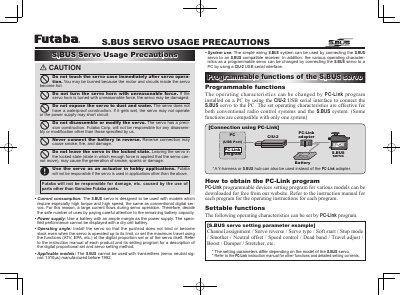
This document outlines critical usage precautions for Futaba S.BUS servos, warning users against touching the hot motor immediately after operation, exposing the unit to dust or water, or leaving it in a locked state. It also notes that the servo is designed for hobby applications and should not be disassembled or modified by the user. Power supply recommendations emphasize using batteries with an ample margin rather than dry cells, and caution against reverse battery connection which can cause fire or damage.
The manual details the S.BUS system, explaining how it uses data communication to transmit control signals to multiple devices like servos and gyros. It describes how to connect S.BUS servos to S.BUS compatible receivers, hubs, or conventional receivers using decoders. Additionally, it covers the use of the PC-Link program via a CIU-2 USB serial interface to set programmable functions such as channel assignment, servo reverse, speed control, and dead band.
No, the servo has a precision construction and Futaba will not be responsible for damage caused by disassembly or modification other than those specified by them.
You should use a battery with an ample margin as the power supply, as performance cannot be displayed with a dry cell battery.