
This document introduces the structure and working principle of IGBTs, as well as their main static and dynamic characteristics. Furthermore, the behavior in operation is analyzed and discussed in more detail to provide a complete overview of the main parameters, features, and static and dynamic behaviors of this power component.
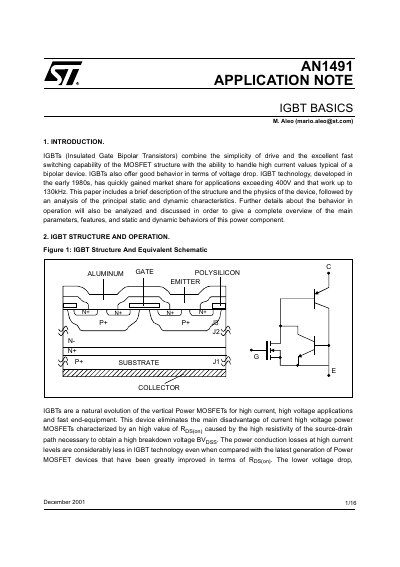
This document provides a comprehensive overview of Insulated Gate Bipolar Transistors (IGBTs), covering their basic structure, physics, and operation principles. It details how IGBTs combine the drive simplicity of MOSFETs with the high current handling capabilities of bipolar devices, making them suitable for high voltage and high current applications exceeding 400V and operating up to 130kHz.
The text analyzes key operational phases including turn-on and turn-off behaviors, explaining the formation of electron and hole currents. It further discusses critical phenomena such as reverse and forward blocking, the risks of latch-up, and forward conduction characteristics. Finally, the document examines dynamic characteristics, focusing on the impact of gate resistance on switching speeds and power losses.
IGBT technology is used for applications exceeding 400V that work up to 130kHz.
The gate drive voltage generally adopted and reported in the datasheets is 15V.