
Introduced the design and features of STMicroelectronics ACS™ (alternating current switches) and compared it with Z01
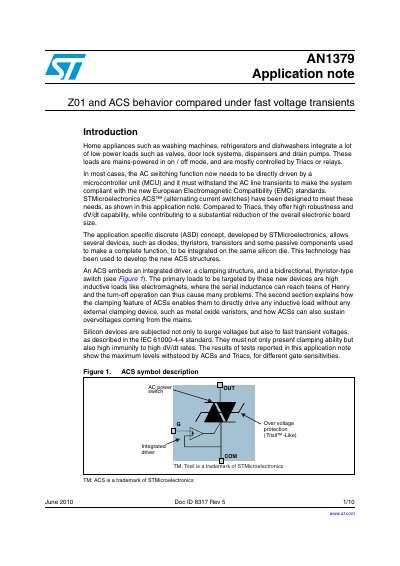
This document explains the advantages of STMicroelectronics ACS (alternating current switches) over traditional Triacs for controlling inductive loads in home appliances. It highlights how ACS devices offer higher robustness and dV/dt capability, allowing them to withstand fast voltage transients without requiring external clamping devices like metal oxide varistors.
The note details the results of fast transient immunity tests based on the IEC 61000-4-4 standard. It compares the performance of various ACS models (such as ACS102-5TA, ACS108-5SA, and ACS402-5SB4) against Triacs (Z0107MA, Z0109MA) under supply and I/O port test conditions, demonstrating the superior noise immunity of ACS technology.
| Test burst duration | 15 ms |
|---|---|
| Test burst frequency | 3 Hz |
| Spike frequency | 5 kHz |
| Test duration | one second |
| Maximum gate current for ACS102-5TA | 5 mA |
| Maximum gate current for ACS108-5SA | 10 mA |
| dV/dt capability for 5 mA sensitivity ACS | 300 V/us |
| dV/dt capability for 10 mA sensitivity ACS | 500 V/us |
No, ACSs are self-protected against overvoltage and do not need external clamping devices such as metal oxide varistors.
A board including four ACS108 in TO92 packages can sustain up to 3.7 kV.
ACSs have significantly higher dV/dt capability; for example, 5 mA sensitivity ACSs sustain 300 V/us while similar Triacs only withstand 20 V/us.