
This document describes various forms of Direct Memory Accesses (DMA) on the TigerSHARC family of processors. Assembly code examples are provided
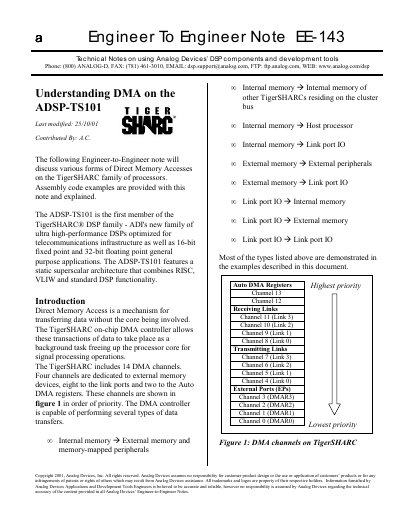
This document serves as an Engineer-to-Engineer note detailing various forms of Direct Memory Access (DMA) on the ADSP-TS101 TigerSHARC family of processors. It explains how the on-chip DMA controller allows data transactions to occur as background tasks, freeing the processor core for signal processing operations. The text outlines the 14 available DMA channels, their priorities, and the specific types of data transfers supported, such as internal to external memory and link port I/O transfers.
| Number of DMA channels | 14 |
|---|---|
| TCB size | 128-bit |
It allows data transactions to take place as a background task, freeing up the processor core for signal processing operations.
Four channels are dedicated to external memory devices.
The TCB is a quad word register consisting of four 32-bit registers.