
This file describes the characteristics and programming methods of the UART port controller of the SHARC processor
This Engineer-to-Engineer Note provides technical details on using the Universal Asynchronous Receiver Transmitter (UART) port controller found in specific Analog Devices SHARC® processors. It covers UART data frame structures, synchronization effects, and interface requirements for EIA-232E communication.
The document outlines programming techniques required to configure full-duplex DMA operations, handle UART interrupts, and establish communication with a PC. It includes examples of assembly code for setting baud rates and configuring line control registers.
| Supported Processor Models | ADSP-21371, ADSP-21375, ADSP-21367, ADSP-21368, ADSP-21369 |
|---|---|
| UART Count per Processor | Two for 21367/21368/21369; One for 21371/21375 |
| Data Frame Length Range | 7 to 12 bits |
| Baud Rate Derivation Source | Processor's peripheral clock |
The document covers ADSP-21371, ADSP-21375, ADSP-21367, ADSP-21368, and ADSP-21369.
They have two UARTs.
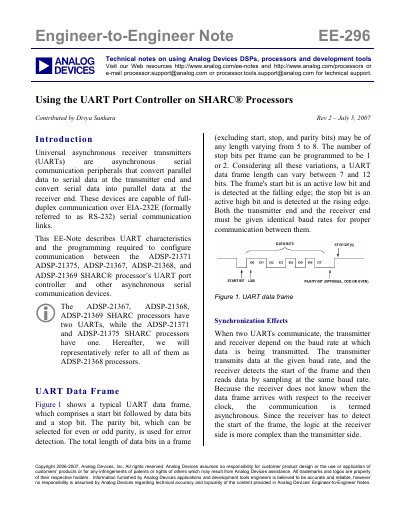
The total length of data bits may vary from 5 to 8.