
Analog Devices AN-399 Interfacing AD1890/AD1891 to AES Receivers

This paper examines the issues with interfacing the AD1890/AD1891 with AES/EBU receivers and digital filters
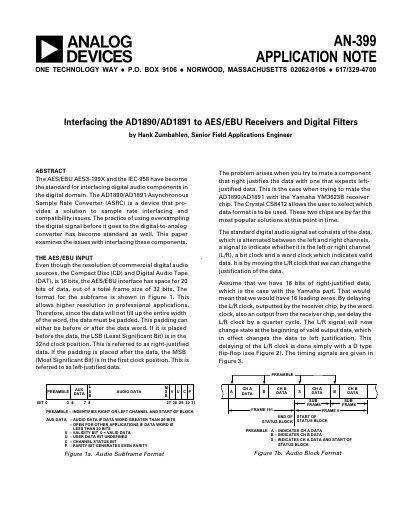

Analog Devices AN-399 Interfacing AD1890/AD1891 to AES Receivers - cover page
Brand
Analog Devices
Category
Other Electronics
Document type
Application Note
Language
English
Pages
2
File format
PDF
File size
85 KB
Published
02 August, 2012
Updated
30 September, 2023
Models
AD1890, AD1891
MD5 checksum
31B65A5F7DE06003C3019839D81DBCBE

About this manual

This document addresses sample rate interfacing and compatibility issues between the AD1890/AD1891 Asynchronous Sample Rate Converter (ASRC) and digital audio components using the AES/EBU (AES3-199X) and IEC-958 standards. It specifically examines the challenges of connecting components that use different data justification formats (right-justified vs. left-justified).

What's inside

  • The AES/EBU Input
  • Justification Change
  • The Interpolation Filter
  • ASRC-Digital Filter Timing
  • Conclusion

Frequently asked questions

What is the standard for interfacing digital audio components in the digital domain?

The AES/EBU AES3-199X and the IEC-958 have become the standard for interfacing digital audio components in the digital domain.

How can data justification be changed from right-justified to left-justified?

Data justification can be changed by delaying the L/R clock outputted by the receiver chip by the word clock, effectively changing the data to left justification.

What is the primary advantage of using oversampling before the digital-to-analog converter?

Oversampling moves images out in frequency, allowing for a much simpler and less expensive lower order filter to be designed.

Download PDF (85 KB)

More Analog Devices Manuals


View all Analog Devices manuals →