
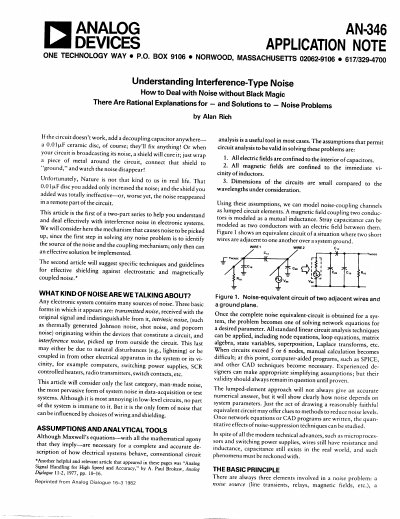
Analog Devices AN-346 Understanding Interference-Type Noise Application Note


Analog Devices AN-346 Understanding Interference-Type Noise Application Note - cover page
Brand
Analog Devices
Document type
Application Note
Language
English
Pages
4
File format
PDF
File size
569 KB
Published
02 August, 2012
Updated
24 August, 2012
MD5 checksum
CFE31F23F1D198E39560377EC08B921F

About this manual

This document is an application note by Alan Rich, titled 'Understanding Interference-Type Noise: How to Deal with Noise without Black Magic.' It serves as the first part of a two-part series aimed at helping engineers understand and effectively deal with interference noise in electronic systems. The text argues against common but ineffective solutions like blindly adding decoupling capacitors or shielding circuits, noting that these can sometimes increase noise.

What's inside

  • Understanding Interference-Type Noise
  • Assumptions and Analytical Tools
  • The Basic Principle of Noise Problems
  • Common-Impedance Noise
  • Capacitively Coupled Noise
  • Magnetically Coupled Noise
  • Power-Line Transients

Frequently asked questions

What is the first step in solving any noise problem?

The first step is to identify the source of the noise and the coupling mechanism.

What repetition rate and duty cycle are typical for switching power supply noise?

A noise waveform at a 25kHz repetition rate with a 25% duty cycle might be typical of such supplies.

What is the total capacitance between two adjacent wires in a 10-foot cable?

If two wires in a 10-foot length of cable have a capacitance of 40 pF/ft, the total capacitance is 400 pF.

Download PDF (569 KB)

More Analog Devices Manuals


View all Analog Devices manuals →