
This document introduces the features and functions of the Extech DM220 Pocket Autoranging Multimeter. The meter can measure AC/DC voltage, AC/DC current, resistance, capacitance, frequency, duty cycle, diode test, and continuity. It also features a built-in non-contact AC voltage detector and flashlight.
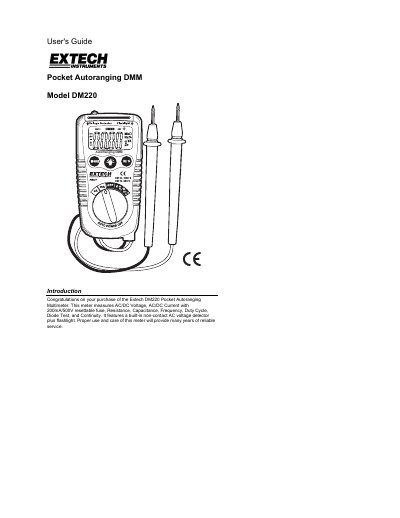
The Extech DM220 is a versatile pocket autoranging multimeter designed to measure AC/DC voltage, AC/DC current (up to 200mA), resistance, capacitance, frequency, duty cycle, diode test, and continuity. It features a built-in non-contact AC voltage detector and an integrated flashlight for convenience in various testing environments.
| Display | 3-3/4 digit (4000 count) LCD |
|---|---|
| DC Voltage Range | 600V DC |
| AC Voltage Range | 600V AC |
| DC Current Range | 200mA |
| AC Current Range | 200mA |
| Resistance Range | 4MΩ |
| Capacitance Range | 200µF |
The auto off feature will turn the meter off after 15 minutes.
Place the detector probe tip next to the hot conductor or insert it into the hot side of an electrical outlet; if AC voltage is present, the light will illuminate.
An icon will appear in the lower left corner of the display to indicate that the battery voltage has become low.