
FZT649 is a NPN low saturation transistor produced by Fairchild Semiconductor Corporation, with high current gain and low saturation voltage, the collector current can reach 3A continuous
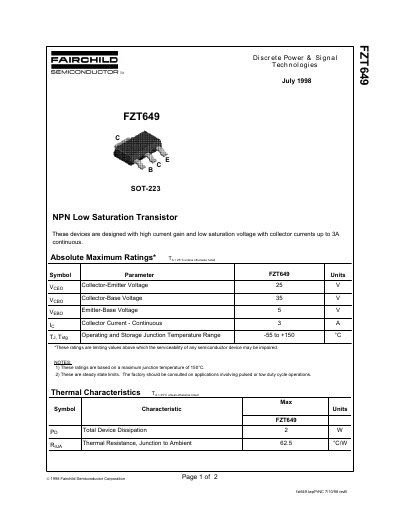
This document is a technical datasheet for the Fairchild Semiconductor FZT649, an NPN Low Saturation Transistor packaged in SOT-223. Designed with high current gain and low saturation voltage, it supports continuous collector currents up to 3A.
The datasheet provides absolute maximum ratings including a collector-emitter voltage of 25V and operating temperatures from -55°C to +150°C. It also lists detailed electrical characteristics for OFF and ON states, such as DC current gain ranging from 70 to 300 depending on conditions, and saturation voltages.
| Package Type | SOT-223 |
|---|---|
| Collector-Emitter Voltage (VCEO) | 25 V |
| Collector-Base Voltage (VCBO) | 35 V |
| Emitter-Base Voltage (VEBO) | 5 V |
| Collector Current (Continuous) | 3 A |
| Operating Junction Temperature Range | -55 to +150 °C |
| Total Device Dissipation (Pd) | 2 W |
The device supports collector currents up to 3A continuous.
The operating and storage junction temperature range is -55°C to +150°C.
The DC current gain ranges from 100 to 300 when Ic=1A and VceE=2V.