
This document describes the features and characteristics of Philips Semiconductors BT131W series logic level triacs, which are suitable for surface mounting and intended for use in general purpose bidirectional switching and phase control applications. These devices can be directly interfaced to microcontrollers, logic integrated circuits, and other low power gate trigger circuits.
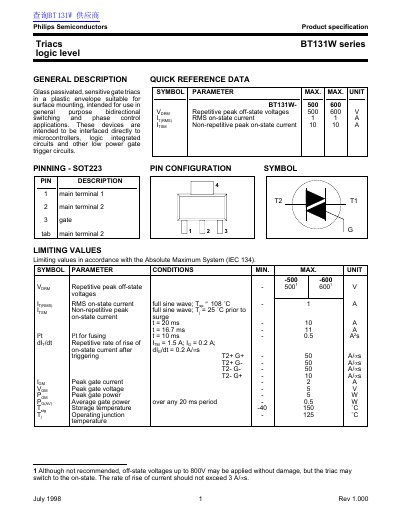
This document is a product specification datasheet for the Philips BT131W series of logic level triacs. These glass passivated devices are designed for surface mounting in a SOT223 package and are intended for general-purpose bidirectional switching and phase control applications. They are specifically designed to be interfaced directly with microcontrollers and other low-power gate trigger circuits.
| Package Type | SOT223 |
|---|---|
| Maximum Repetitive Peak Off-State Voltage | 600 V |
| RMS On-State Current | 1 A |
| Non-Repetitive Peak On-State Current | 10 A |
| Operating Junction Temperature | -125 °C |
| Gate Trigger Current (T2+ G+) | 3 mA |
| Latching Current (T2+ G+) | 5 mA |
| Net Mass | 0.11 g |
The maximum operating junction temperature is 125 °C.