
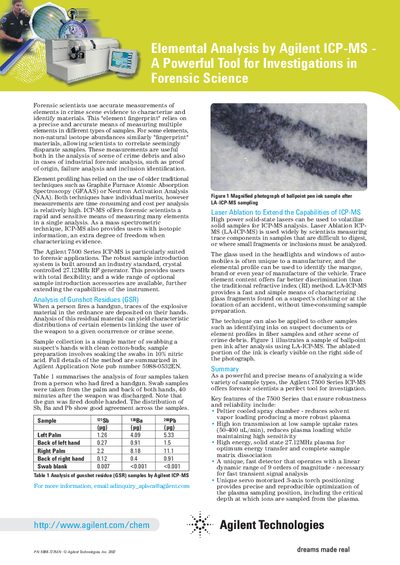
This file introduces the application of Agilent ICP-MS in forensic science. This technology can be used to analyze traces of components in samples that are difficult to digest, or where small fragments or inclusions must be analyzed. The technique can also be applied to other samples, such as identifying inks on suspect documents or element profiles in fiber samples and other crime scene debris.
The Agilent 7500 Series ICP-MS is presented as a powerful tool for forensic scientists to characterize and identify materials through accurate elemental measurements. The document highlights how this technique provides an 'element fingerprint' useful for analyzing crime scene debris, industrial forensic analysis, and proof of origin.
| RF Generator Frequency | 27.12MHz |
|---|---|
| Sample Uptake Rate Range | 50-400 uL/min |
| Dynamic Range | 9 orders of magnitude |
ICP-MS offers a rapid and sensitive means of measuring many elements in a single analysis.
It is used to characterize glass fragments found on clothing or at accident locations without time-consuming sample preparation.