
This document describes the operating procedures for using ammonia as a reagent gas for chemical ionization, as well as the characteristics and hardware requirements of ammonia. Ammonia is widely used for both positive and negative chemical ionization.
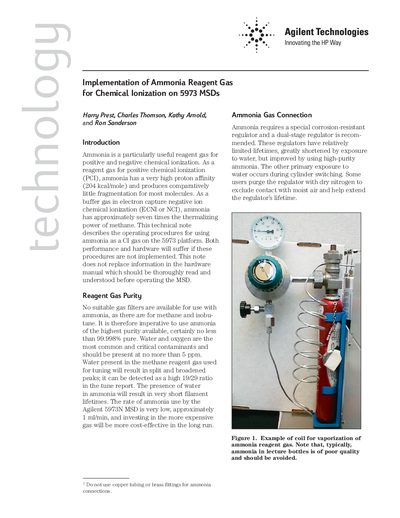
This document details the implementation of ammonia reagent gas for positive and negative chemical ionization on the Agilent 5973N Mass Spectrometry Detector (MSD). It highlights that ammonia is useful for positive chemical ionization due to its high proton affinity and for electron capture negative ion chemical ionization due to its thermalizing power. The text emphasizes the necessity of using high-purity ammonia (99.998% or greater) to prevent issues like split peaks and short filament lifetimes caused by water and oxygen contaminants.
| Ammonia Purity Requirement | 99.998% or greater |
|---|---|
| Water and Oxygen Limit | no more than 5 ppm |
| Ammonia Usage Rate | approximately 1 ml/min |
| Regulator Pressure Setting | less than 20 psi |
| Pump Ballasting Duration | 30 minutes |
| Pump Oil Change Frequency | at least every three months |
The ammonia must be of the highest purity available, certainly no less than 99.998% pure.
Water and oxygen are the most common and critical contaminants, which should be present at no more than 5 ppm.
The pump oil must be changed at least every three months, preferably more frequently.
It is necessary to ballast the pump for 30 minutes every day after using ammonia gas to flush out volatile components.