
This document introduces a new method for protein detection on the Agilent 2100 bioanalyzer based on fluorescent labeling. The method has high sensitivity, a large linear dynamic range, can detect impurities, and is fast and reliable.
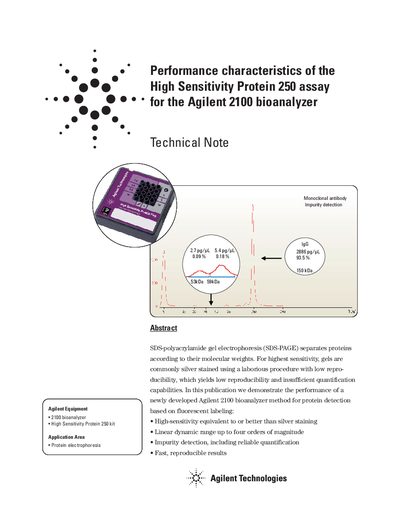
This document presents a technical evaluation of the Agilent High Sensitivity Protein 250 assay, designed for the Agilent 2100 Bioanalyzer. It serves as a superior alternative to traditional silver staining methods for SDS-PAGE, offering high sensitivity and excellent reproducibility for protein detection and quantification. The assay utilizes fluorescent labeling to analyze proteins within a range of 10 to 250 kDa.
The publication details experimental results verifying the assay's linear dynamic range of four orders of magnitude and its ability to detect minor impurities and low-concentration proteins. It compares the performance against standard silver staining protocols and provides data on sensitivity, reproducibility, and the impact of salt concentration on sample analysis.
| Protein size range | 10 to 250 kDa |
|---|---|
| Linear dynamic range | four orders of magnitude |
| Lower detection limit (on-chip) | 0.4 pg/pL |
| Lower detection limit (PBS) | 5 pg/pL |
| Correlation coefficient (R²) | 0.995 to 0.999 |
The assay is affected by salt concentration; for example, detection limits in PBS are higher than in water.
The assay analyzes proteins from 10 to 250 kDa.
The assay can reproducibly detect BSA at an on-chip concentration of 0.4 pg/pL.
The kit includes 10 chips for 100 samples.