
A method based on isotopic dilution with low resolution MRM acquisition for higher sensitivity was used for the determination of polychlorinated dibenzo-p-dioxins and dibenzofurans in sediments. The method is accurate and sensitive.
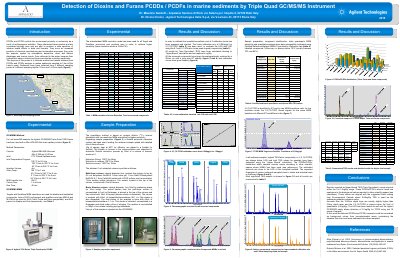
This document presents a method for detecting dioxins (PCDDs) and furans (PCDFs) in marine sediments. The analysis was conducted using an Agilent 7000 Series Triple Quad GC/MS/MS instrument with a 60m HP5-MS Ultra Inert capillary column. The study focused on samples collected from six different points off the Lazio coast, Italy, at depths of 0-5cm and 15-20cm.
| Column | 60m HP5-MS Ultra Inert capillary column |
|---|---|
| Inlet Mode | PTV Pulsed Splitless mode |
| Injection Volume | 4uL |
| Run Time | 40 min |
The method uses 10g of sediment kept at 40°C for 48 hours before Soxhlet extraction.
The complete chromatographic run takes 40 minutes to complete.