
This document provides a technical overview of the METLIN Personal Compound Database and Library (PCDL) for metabolite identification. The system uses accurate mass, retention time, and MS/MS spectra matching for compound identification. By combining multiple analytical information, confidence in identifying unknown compounds can be increased.
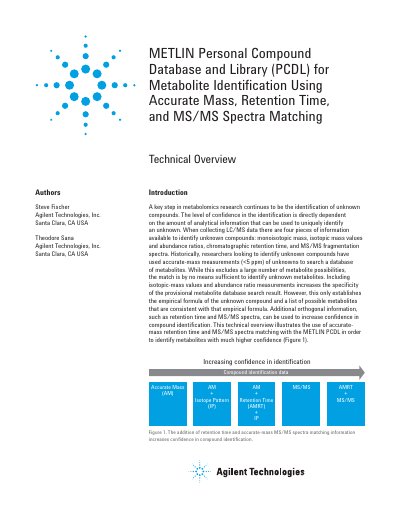
The document introduces the METLIN PCDL as a tool for identifying unknown compounds in metabolomics research. It highlights that while accurate-mass measurements are useful, they often exclude too many possibilities or lack sufficient specificity. The database combines monoisotopic mass, isotopic patterns, retention time, and MS/MS fragmentation spectra to uniquely identify compounds.
The METLIN PCDL contains approximately 25,000 compounds, with over 670 including measured retention times and more than 2,270 having accurate-mass quadrupole time-of-flight (Q-TOF) MS/MS reference spectra. The data was generated using Agilent Q-TOF LC/MS instruments under rigorous quality control to ensure high-confidence identifications.
| Number of compounds in database | approximately 25,000 |
|---|---|
| Compounds with measured retention times | more than 670 |
| Collision energies used for spectra | 10, 20, and 40 eV |
The database uses accurate-mass measurements, isotopic mass values and abundance ratios, chromatographic retention time, and MS/MS fragmentation spectra.
Spectra were generated from standards using multiple Agilent Q-TOF LC/MS instruments in both positive and negative ion modes at three collision energies, followed by rigorous quality control.
Retention time serves as an orthogonal measurement to accurate mass, increasing confidence in compound identification and helping distinguish structural isomers.