
The document describes the features and characteristics of the MM74C922 and MM74C923 CMOS key encoders. They provide all the necessary logic to fully encode an array of SPST switches. These encoders also have on-chip pull-up devices which permit switches with up to 50 kΩ on resistance to be used. No diodes in the switch array are needed to eliminate ghost switches. The internal debounce circuit needs only a single external capacitor and can be defeated by omitting the capacitor. A Data Available output goes to a high level when a valid keyboard entry has been made. The Data Available output returns to a low level when the entered key is released, even if another key is depressed. The Data Available will return high to indicate acceptance of the new key after a normal debounce period; this two-key roll-over is provided between any two switches. An internal register remembers the last key pressed even after the key is released. The 3-STATE outputs provide for easy expansion and bus operation and are LPTTL compatible.
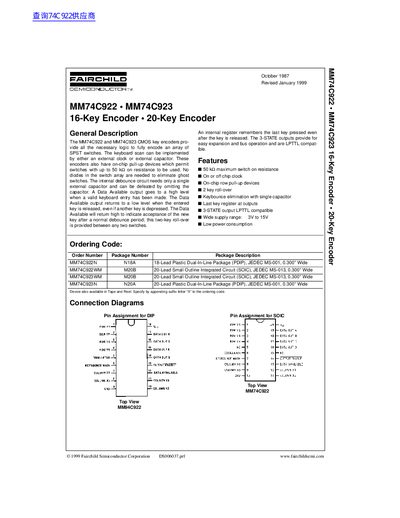
This document is a technical datasheet for the Fairchild Semiconductor MM74C922 (16-Key Encoder) and MM74C923 (20-Key Encoder). These CMOS key encoders provide logic to fully encode arrays of SPST switches, supporting keyboard scan implementations via external clock or capacitor. The devices feature on-chip pull-up devices allowing for switch resistances up to 50 kΩ without external diodes and include an internal debounce circuit requiring only a single external capacitor.
| Maximum switch on resistance | 50 kΩ |
|---|---|
| Supply voltage range | 3V to 15V |
| Operating temperature range (MM74C922, MM74C923) | -40°C to +85°C |
| Storage temperature range | -65°C to +150°C |
| Power Dissipation (Dual-In-Line) | 700 mW |
| Power Dissipation (Small Outline) | 500 mW |
No, no diodes are needed to eliminate ghost switches.
It requires only a single external capacitor and can be defeated by omitting the capacitor.