
Agilent LC Troubleshooting Series Peak Broadening introduces the possible causes of peak broadening and solutions
This document is part of the Agilent LC Troubleshooting Series, presented as video notes by Application Scientists Mike Woodman and Bill Long. It addresses the issue of peak broadening in Liquid Chromatography (LC) systems, detailing various potential causes such as improper fittings, excessive tubing volume, mobile phase issues, system settings, injection overload, and gradient design errors.
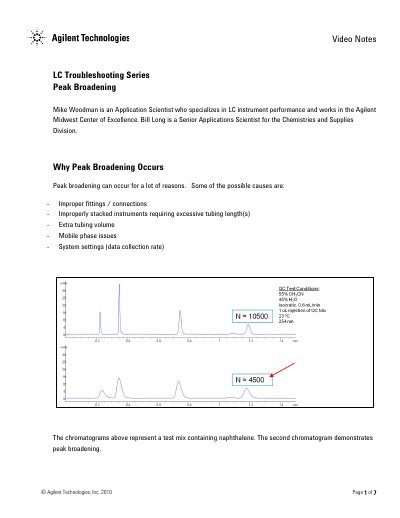
Peak broadening can occur due to improper fittings/connections, improperly stacked instruments requiring excessive tubing length, extra tubing volume, mobile phase issues, or system settings like data collection rate.
Agilent recommends using Swagelok fittings or preferably fingertight fittings, specifically Stainless Steel (SS) fittings which are the best choice for reliable high pressure sealing.
Reducing extra tubing volume is critical to prevent peak broadening, particularly when working with high efficiency columns. Using 0.12 mm tubing instead of 0.17 mm reduces tubing volume by one-half.
If the injection volume is too high, it can overload the column and cause peak broadening. The document demonstrates this with chromatograms showing increasing peak width as injection volumes rise from 1 uL to 50 uL.