
This document describes the safe use of Agilent Bio MAb columns, including preparation before use and precautions during use.
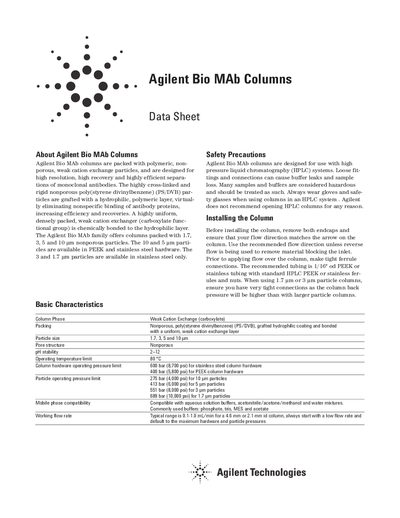
The document describes the Agilent Bio MAb column family, which utilizes polymeric, nonporous, weak cation exchange particles grafted with a hydrophilic layer. This design aims to provide high resolution and recovery for monoclonal antibody separations while virtually eliminating nonspecific binding.
Key specifications include particle sizes of 1.7, 3, 5, and 10 micrometers, available in either PEEK or stainless steel hardware (depending on size). The columns operate within a pH range of 2-12 with a maximum temperature limit of 80 °C.
| Particle Size | 1.7, 3, 5 and 10 um nonporous particles |
|---|---|
| Column Phase | Weak Cation Exchange (carboxylate) |
| Pore Structure | Nonporous |
| pH Stability Range | 2-12 |
| Operating Temperature Limit | 80 °C |
| Stainless Steel Hardware Pressure Limit | 600 bar (8,700 psi) |
| PEEK Hardware Pressure Limit | 400 bar (5,800 psi) |
| Working Flow Rate Range | 0.1-1.0 mL/min (for 4.6 mm or 2.1 mm id) |
The columns are compatible with aqueous solution buffers, acetonitrile/acetone/methanol and water mixtures. Commonly used buffers include phosphate, tris, MES and acetate.
Yes, the main column can be flushed in the reverse direction with 50 mM phosphate buffer, 1M NaCl, pH 10 for at least 15 column volumes.
For extended storage, flush the column using 20 mM phosphate buffer with 0.1% sodium azide at pH 6.0 and seal both ends.