
The Agilent Millipede coil allows the use of high-field vertical magnets for imaging. It makes efficient use of space inside the magnet, which is critical for micro-imaging applications, particularly preclinical studies. The unique Millipede design reduces the intensity of flip-angle related image artifacts, eliminating error in data interpretation. Optimized circuit design coupled with quadrature detection yields superior signal-to-noise ratio, reducing the acquisition time. Improved RF homogeneity allows placing samples closer to the coil edges, enabling imaging of samples as large as rodents in a vertical bore magnet.
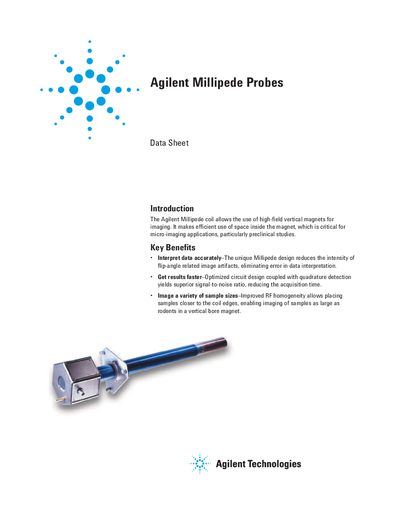
The Agilent Millipede coil is designed for use with high-field vertical magnets, making efficient use of space for micro-imaging applications, particularly preclinical studies. The unique design reduces flip-angle related image artifacts, while optimized circuit design and quadrature detection improve the signal-to-noise ratio and acquisition time. Improved RF homogeneity allows for imaging of larger samples, such as rodents, closer to the coil edges.
| Clean id | 20 mm, 30 mm, 40 mm |
|---|---|
| Homogenous region | 80% of the coil id |
It allows the use of high-field vertical magnets for imaging, making efficient use of space inside the magnet.
It reduces the intensity of flip-angle related image artifacts, eliminating error in data interpretation.
Yes, improved RF homogeneity allows placing samples closer to the coil edges, enabling imaging of samples as large as rodents.