
Agilent 400-MR Fast Effective Lineshape Optimization Data Sheet

Agilent's 400-MR uses rapid gradient shimming methods to optimize lineshape prior to data acquisition, resulting in improved sensitivity and data quality for organic and inorganic molecules in various solvents.
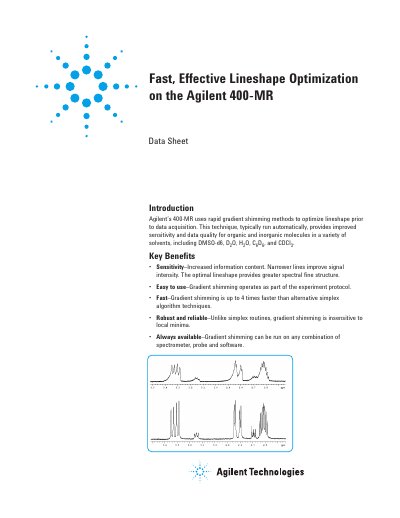

Agilent 400-MR Fast Effective Lineshape Optimization Data Sheet - cover page
Brand
Agilent
Category
Other Electronics
Document type
Datasheet
Language
English
Pages
2
File format
PDF
File size
8.7 MB
Published
04 July, 2012
Updated
28 September, 2023
Model
400-MR
MD5 checksum
03D2539D2724B53A3AD1C4E820325AE4

About this manual

The Agilent 400-MR utilizes rapid gradient shimming methods to optimize lineshape prior to data acquisition. This technique, typically run automatically, provides improved sensitivity and data quality for organic and inorganic molecules in a variety of solvents. Key benefits include increased information content, ease of use, speed (up to 4 times faster than simplex algorithms), and robustness against local minima.

What's inside

  • Introduction
  • Key Benefits
  • Gradient Shimming Methods
  • Proton or Deuterium Gradient Shimming
  • Applications

Frequently asked questions

What is the primary function of the Agilent 400-MR regarding lineshape optimization?

It uses rapid gradient shimming methods to optimize lineshape prior to data acquisition.

How much faster is gradient shimming compared to simplex algorithm techniques?

Gradient shimming is up to 4 times faster than alternative simplex algorithm techniques.

How long does the shimming process take for the sample of ethylindanone shown in the document?

The shimming process took less than 1 minute.

Download PDF (8.7 MB)

More Agilent Manuals


View all Agilent manuals →