
FastMAS and UltraFastMAS probes provide high-resolution 1H spectra and increased sensitivity per milligram for 600 MHz NMR experiments.
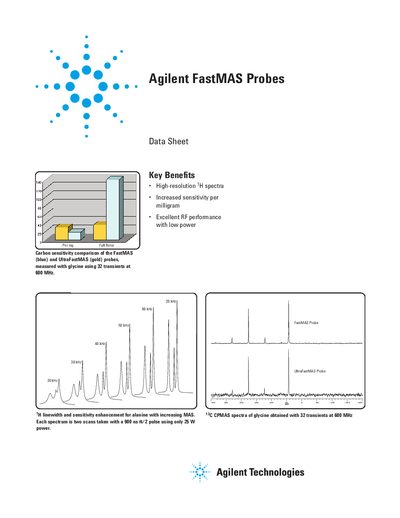
The document presents a data sheet for Agilent FastMAS and UltraFastMAS probes, highlighting their key benefits such as high-resolution spectra and excellent RF performance with low power. It compares the carbon sensitivity of these probes against the UltraFastMAS model using glycine measurements at 600 MHz.
The text illustrates the impressive 'H sensitivity supporting multidimensional NMR experiments, specifically showing a 2D exchange spectrum for ethylfumarate. It also describes the PIPS (PI Pulses) decoupling scheme, which allows efficient low-power decoupling at spinning speeds of 45 kHz or higher.
The probes offer high-resolution 'H spectra, increased sensitivity per milligram, and excellent RF performance with low power.
PIPS (PI Pulses) is a low average power sequence used for spin exchange suppression at spinning speeds of 45 kHz or higher, requiring only knowledge of pulse width and spinning speed.