
This document describes the stability, selectivity, and sensitivity of the dual plasma sulfur and nitrogen chemiluminescence detectors from Agilent Technologies. The detectors utilize dual plasma technology to optimize combustion of the sample matrix and formation of either sulfur monoxide (SO) or nitric oxide (NO), resulting in unsurpassed stability, selectivity, and sensitivity.
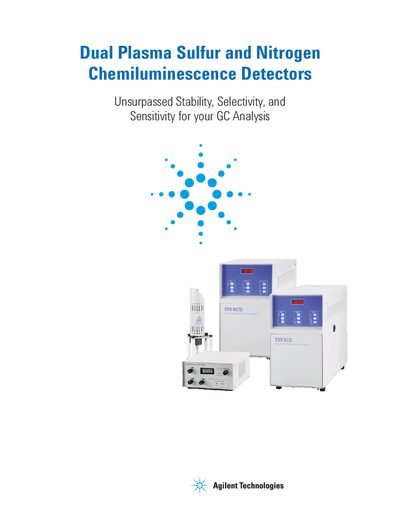
Agilent Technologies has developed a new Dual Plasma Technology to enhance its Sulfur (355 SCD) and Nitrogen (255 NCD) Chemiluminescence Detectors. This system utilizes a patented two-flame plasma combustion method that optimizes the formation of sulfur monoxide or nitric oxide, resulting in unsurpassed stability, selectivity over carbon, and sensitivity.
| Detection Limit | Picogram detection limits |
|---|
The detector utilizes the combustion of sulfur compounds to form sulfur monoxide (SO) and the subsequent chemiluminescence reaction of SO with ozone (O3).
The detector is used for chemicals, environmental samples, food and beverages, fuels, gases, pesticides and herbicides, petrochemicals, polymers, and nitrosamines.