
Agilent 6300 Series Ion Trap LC/MS Systems are flexible high-performance LC/MSn solutions that match your applications and budget. Whether you are searching for low-abundance proteins, drug metabolites in complex matrices, or pesticide residues in food products, there is a 6300 Series Ion Trap LC/MS system to meet your needs.
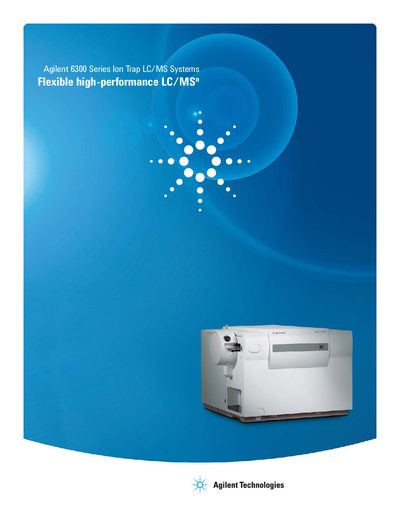
The Agilent 6300 Series Ion Trap LC/MS Systems offer unprecedented flexibility with four performance levels tailored to various analytical challenges, from low-abundance proteins to pesticide residues. The series includes the 6310, 6320, 6330, and 6340 models, each designed to meet specific needs regarding sensitivity, mass resolution, and scan speed.
| Scan speed (6320 Trap) | 26,000 u/s |
|---|---|
| Resolution (6320 Trap) | better than unit resolution |
| Scan speed (6320 Trap analysis) | 8,100 u/s |
ETD provides more even fragmentation across a peptide than CID, enhancing sequence coverage and allowing the specific location of post-translational modifications to be determined.
The 6320 Trap can scan at 26,000 u/s with better than unit resolution.
The 6330 Trap analyzed 1 femtomole of BSA digest on column.
Electrospray is available at standard, capillary (microliter), and nanoliter flow rates.