
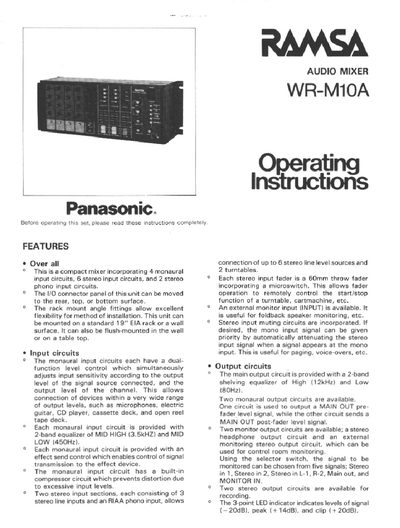
This document provides operating instructions for the RAMSA WR-M10A, a compact audio mixer designed for professional applications. The unit incorporates four monaural input circuits and six stereo input circuits (including two phono inputs), allowing connection of microphones, instruments, CD players, and turntables.
The manual details the features of the input sections, including dual-function level controls, 2-band equalizers, built-in compressors to prevent distortion, and effect send/return capabilities. It also covers output circuits for main monitoring, recording, and external foldback speakers.
| Input Circuits (Mono) | 4 monaural input circuits |
|---|---|
| Mono Input Equalizer | MID HIGH (3.5kHz) and MID LOW (450Hz) |
| Stereo Input Fader Throw | 60mm throw fader incorporating a micraswitch |
| Main Output Equalizer | High (12kHz) and Low (80Hz) |
| LED Indicators | -20dB, peak (+14dB), clip (+20dB) |
When activated, it attenuates stereo input signals when a mono signal appears, giving the mono signal higher priority at the main output.
It prevents distortion due to excessive input levels by limiting the signal sent to the main output section.
Yes, each stereo input fader incorporates a microswitch that allows remote start/stop operation of external devices like turntables.