
bq2056 is a low-cost high-precision Li-Ion battery charge-control device with automatic charge-rate compensation (AutoComp), trickle-charger interface output, single-cell 4.1V, and two-cell 8.2V
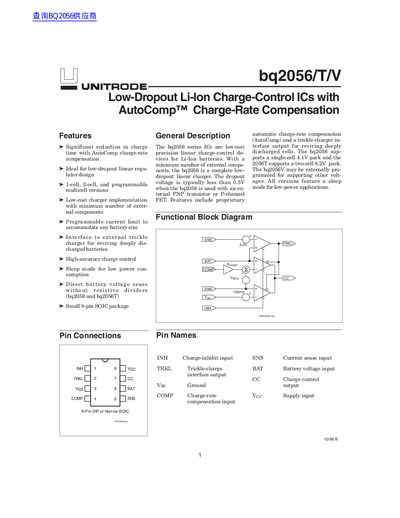
The BQ2056 series ICs are low-cost precision linear charge-control devices designed for Lithium-ion (Li-Ion) batteries. They support configurations for one cell, two cells, and programmable multicell versions with a minimum number of external components. Key features include proprietary automatic charge-rate compensation (AutoComp), a trickle-charge interface output to revive deeply discharged batteries, high-accuracy charge control, and a sleep mode for low-power applications.
| Voltage regulation reference (bq2056) | 4.10 V ±1% |
|---|---|
| Voltage regulation reference (bq2056T) | 8.20 V ±1% |
| Voltage regulation reference (bq2056V) | 3.35 V ±1% |
| Current regulation reference | 100 mV ±15% |
| Operating ambient temperature | -20 to 70 °C |
| Storage temperature | -40 to 125 °C |
| Power dissipation | 300 mW |
AutoComp compensates safely for internal impedance of the battery and voltage drops in protection circuitry to maximize capacity while reducing charging time.
The TRKL output is driven low if the battery voltage is less than an internal threshold level, enabling an external trickle charger to revive deeply discharged batteries.
When INH is driven high, internal current consumption is reduced and pins CC and TRKL assume a high-impedance output state.