
This document describes the features and characteristics of the bq2002E and bq2002G Fast-Charge ICs, including fast charging of nickel cadmium or nickel-metal hydride batteries, direct LED output for displaying charge status, various methods for fast charge termination, optional top-off charge, selectable pulse trickle charge rates, and low-power mode.
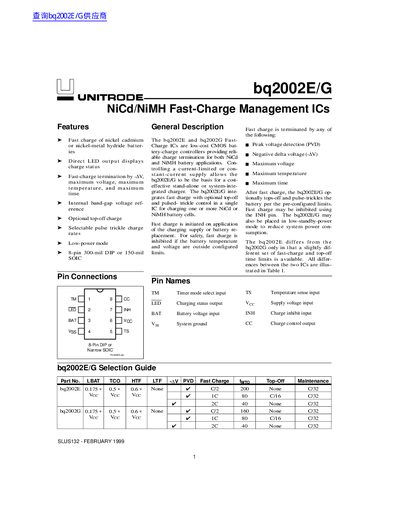
The bq2002E and bq2002G are low-cost CMOS battery-charge controllers designed for reliable charge termination of nickel cadmium (NiCd) and nickel-metal hydride (NiMH) batteries. These integrated circuits control current-limited or constant-current supplies to serve as stand-alone or system-integrated chargers. They integrate fast charge, optional top-off, and pulsed-trickle control into a single IC package.
| Battery Chemistry | NiCd or NiMH |
|---|---|
| Package Types | 8-pin 300-mil DIP or 150-mil SOIC |
| Charge Termination Methods | Peak voltage detection, Negative delta voltage, Maximum voltage, Maximum temperature, Maximum time |
| Trickle Charge Rate | C/32 |
The bq2002E/G supports nickel cadmium (NiCd) and nickel-metal hydride (NiMH) batteries.
Fast charge is terminated by peak voltage detection, negative delta voltage, maximum voltage, maximum temperature, or maximum time.
The pulse-trickle charge results in a trickle rate of C/32.