
The bq2031 is a lead-acid battery fast charge ic that can achieve constant voltage, constant current or pulsed current charging, and can set the regulator frequency by an external capacitor for design flexibility. The switch-mode design keeps power dissipation to a minimum, suitable for high charge current applications. A charge cycle begins when power is applied or the battery is replaced. For safety, charging is inhibited until the battery voltage is within the configured limits.
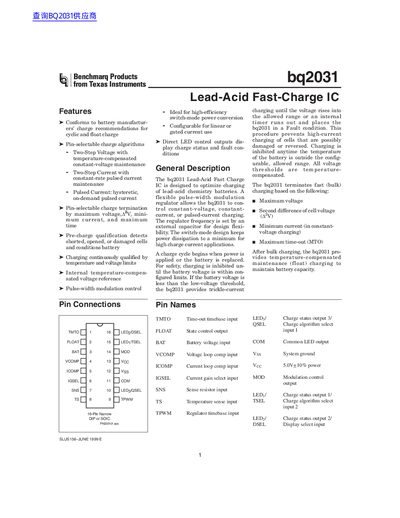
The bq2031 is a Lead-Acid Fast-Charge IC designed to optimize charging of lead-acid chemistry batteries. It features a flexible pulse-width modulation regulator that allows for constant-voltage, constant-current, or pulsed-current charging, with the regulator frequency set by an external capacitor. The device is ideal for high-efficiency switch-mode power conversion and can be configured for linear or gated current use.
The IC includes features such as pin-selectable charge algorithms (Two-Step Voltage, Two-Step Current, and Pulsed Current), charge termination based on maximum voltage, minimum current, and maximum time, and pre-charge qualification to detect shorted, opened, or damaged cells. It also provides direct LED control outputs to display charge status and fault conditions.
| Product Type | Lead-Acid Fast-Charge IC |
|---|---|
| Package Type | 16-Pin Narrow DIP or SOIC |
| Supply Voltage | 5.0V +/- 10% |
| Charge Algorithms | Two-Step Voltage, Two-Step Current, Pulsed Current |
| Charge Termination Criteria | Maximum voltage, Minimum current, Maximum time-out |
The bq2031 offers Three charge algorithms: Two-Step Voltage, Two-Step Current, and Pulsed Current.
The regulator frequency is set by an external capacitor for design flexibility.
No, the bq2031 does not distinguish between them and enters the Fault state for either condition.