
This document describes an alternative to 2D gel electrophoresis based on isoelectric point OFFGEL electrophoresis and high-sensitivity on-chip protein detection using the Agilent 2100 bioanalyzer.
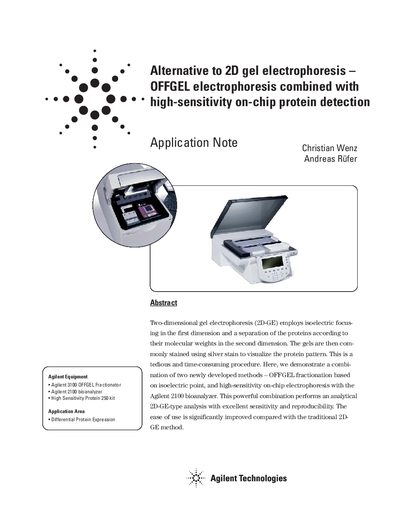
Two-dimensional gel electrophoresis (2D-GE) is traditionally tedious and time-consuming. This document presents an alternative approach using a combination of two Agilent methods: OFFGEL fractionation based on isoelectric point and high-sensitivity on-chip electrophoresis.
The workflow utilizes the Agilent 3100 OFFGEL Fractionator for sample separation followed by analysis with the Agilent 2100 bioanalyzer using the High Sensitivity Protein 250 kit. This combination offers improved ease of use, reproducibility, and sensitivity compared to traditional gel staining methods.
| Protein separation range | 10 to 250 kDa |
|---|---|
| Sensitivity comparison | equivalent to or better than silver staining |
| Dynamic range | four orders of magnitude |
| Kit part number | 5067-1575 |
| OFFGEL kit pH range | pH 3-10 |
The High Sensitivity Protein 250 assay allows for the separation of proteins ranging from 10 to 250 kDa.
The mixture must be incubated on ice for 30 minutes following the addition of the fluorescent labeling dye.
Samples must be incubated at 95-100 °C for 5 minutes after two microliters of sample buffer containing DTT are added.