
The document introduces the features of the SMA series 400 watt peak power zener transient voltage suppressors. They have excellent clamping capability, high surge capability, low zener impedance, and fast response time. They are suitable for use in communication systems, automotive, numerical controls, process controls, medical equipment, business machines, power supplies, and many other industrial/consumer applications.
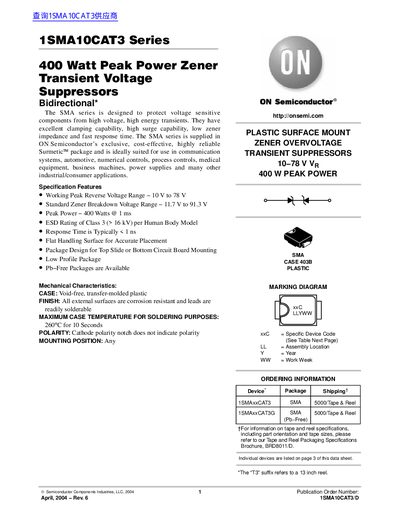
The document describes the 1SMA10CAT3 Series as bidirectional devices designed to protect voltage-sensitive components from high voltage, high energy transients. These suppressors feature excellent clamping capability, high surge capability, low zener impedance, and a fast response time of typically less than 1 ns.
| Peak Power | 400 Watts @ 1 ms |
|---|---|
| ESD Rating | > 16 kV per Human Body Model |
| Response Time | < 1 ns |
| Operating Temperature Range | -65 to +150 °C |
The working peak reverse voltage ranges from 10 V to 78 V.
The standard zener breakdown voltage ranges from 11.7 V to 91.3 V.
Yes, the flat handling surface allows for accurate placement in either top slide or bottom circuit board mounting positions.