
This document provides the characteristics, parameters and package dimensions of BC546B/BC547B/BC548B NPN silicon amplifier transistors.
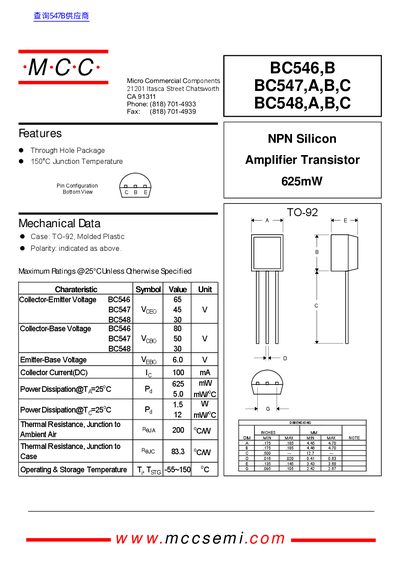
This document provides a comprehensive technical overview of the MCC BC546, BC547, and BC548 series of NPN silicon amplifier transistors. It details maximum ratings such as collector-emitter voltage (up to 65V for BC546) and power dissipation, alongside mechanical specifications including TO-92 molded plastic packaging.
The datasheet includes extensive electrical characteristics tables defining DC current gain ($h_{FE}$), saturation voltages, and small-signal parameters like bandwidth product and capacitance. It also features normalized graphs illustrating performance curves for collector current, temperature coefficients, and frequency response across the different model variants.
| Case Type | TO-92, Molded Plastic |
|---|---|
| Junction Temperature | 150°C |
| Collector-Emitter Voltage (BC546) | 65V |
| Collector-Base Voltage (BC546) | 80V |
| Emitter-Base Voltage | 6.0 V |
| Collector Current (DC) | 100 mA |
| Power Dissipation @ TA=25°C (BC546/BC547) | 625 mW |
| Power Dissipation @ TC=25°C (BC548) | 12 W |
| Operating Temperature Range | -55~150°C |
The maximum collector-emitter voltage (VCEO) for the BC546 is 65V.
The DC current gain ($h_{FE}$) for the BC547 ranges from a minimum of 110 to a maximum of 800.
The thermal resistance, junction to ambient air (RθJA), is 200 °C/W.