
The SN54HC74 and SN74HC74 are dual D-type positive-edge-triggered flip-flops with clear and preset functions. They have a wide operating voltage range of 2V to 6V; the outputs can drive up to 10 LSTTL loads; the power consumption is low, with a maximum ICC of 40µA; the typical tpd is 15 ns; the output drive at 5V is ±4mA; and the input current is at least 1µA.
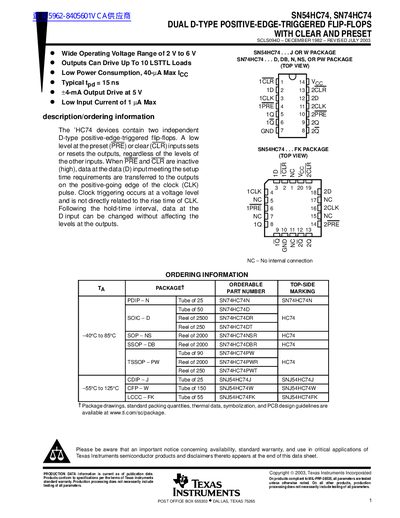
The document describes the SN54HC74 and SN74HC74 devices, which are dual D-type positive-edge-triggered flip-flops with clear and preset inputs. These components feature a wide operating voltage range of 2 V to 6 V and low power consumption. The datasheet includes a function table, logic diagram, and pinout descriptions.
| Supply Voltage Range | 2 V to 6 V |
|---|---|
| Output Drive Capability | Up to 10 LSTTL Loads |
| Max Power Consumption | 40 µA |
| Typical Propagation Delay | 15 ns |
| Output Drive Current at 5 V | +4 mA |
| Operating Temperature (SN54HC74) | -55°C to 125°C |
The maximum clock frequency is 25 MHz at 5V.
The devices operate with a supply voltage ranging from 2 V to 6 V.
The outputs can drive up to 4 mA at 5 V.