
This application note describes the benefits of the Agilent 2100 bioanalyzer in real-time quantitative PCR (QPCR) experiments. The results show that the Agilent 2100 bioanalyzer is an indispensable tool to ensure experimental success by verifying RNA template quality prior to QPCR experiments and to improve the assay design and validation process by monitoring size and purity of the QPCR amplicons.
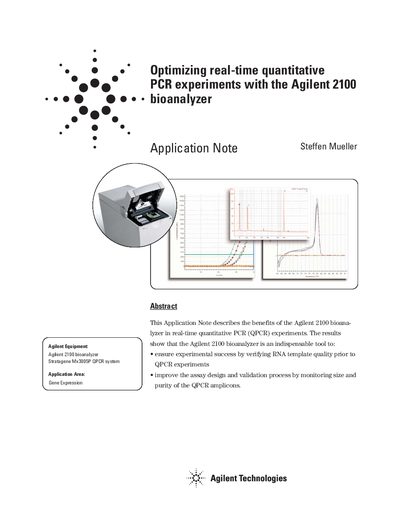
This document describes the benefits of using the Agilent 2100 Bioanalyzer in real-time quantitative PCR (QPCR) experiments. It highlights how the device ensures experimental success by verifying RNA template quality prior to QPCR, specifically through the use of the RNA Integrity Number (RIN) algorithm.
The note further explains how the bioanalyzer improves assay design and validation. By monitoring the size and purity of QPCR amplicons using the DNA 1000 assay, researchers can overcome limitations associated with SYBR Green melt curve analysis, such as difficulty in identifying specificity when products melt at similar temperatures to primer dimers.
The RNA Integrity Number (RIN) algorithm established as the standard tool for assessing RNA integrity.
It allows researchers to monitor the degradation level of RNA samples, which is an important parameter when designing primers and probes.
The DNA 1000 assay was used to assess the size and purity of all amplicons generated.