
This application note presents a method developed using the Agilent 1290 Infinity LC Method Development System and the Agilent Method Scouting Wizard software for the analysis of 20 amines derived from banned azo dyes. Different columns, mobile phases, and temperatures were screened in an automated manner. Initial screening analyses were performed using LC-MS, while method optimization was done with diode-array detection. The performance of the final method was evaluated.
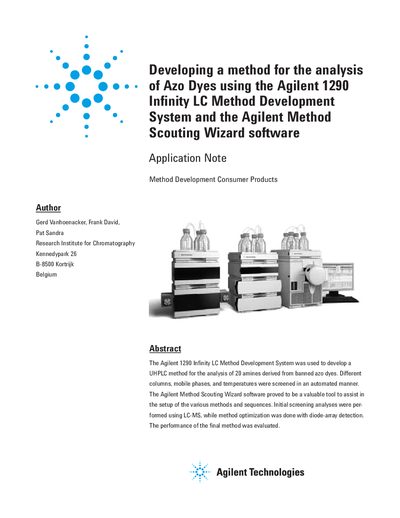
The document details an automated method development process for separating 20 aromatic amines resulting from the reductive cleavage of azo dyes. The study utilized the Agilent 1290 Infinity LC Method Development System combined with the Agilent Method Scouting Wizard software to screen various columns, mobile phases, and temperatures automatically.
Initial screening was performed using LC-MS detection, followed by optimization using a diode-array detector (DAD). The process evaluated different stationary phases, including Agilent ZORBAX RRHD Eclipse Plus C18 and StableBond C18, as well as various mobile phase compositions involving ammonium formate/formic acid at pH 4.45.
| Flow rate | 0.3 mL/min (automatically adjusted for 2.0 mm ID column) |
|---|---|
| Injection volume | 2 uL |
| Peakwidth limit | >0.025 min (10 Hz) |
| Wavelength range | 200-400 nm |
| Ionization mode | Electrospray positive ionization |
The Agilent Method Scouting Wizard software is used to assist with the automated method development.
Initial screening analyses were performed using LC-MS, while method optimization was done with diode-array detection.
Ammonium formate provides better selectivity and peak spreading than formic acid.