
This document introduces the features and characteristics of the HVD2x family transceivers, including voltage range, receiver equalization, unit load, bus I/O protection, receiver hysteresis and so on.
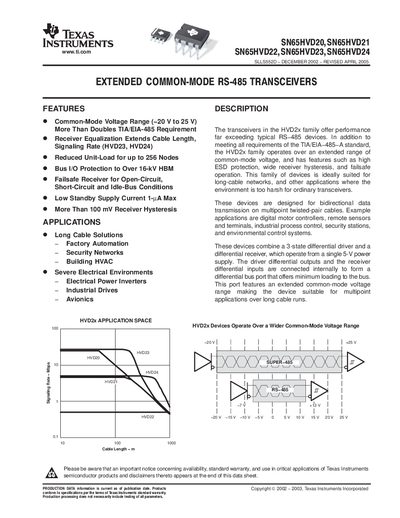
The SN65HVD2x family of transceivers from Texas Instruments offers performance exceeding typical RS-485 devices by operating over an extended range of common-mode voltage. These devices are designed for bidirectional data transmission on multipoint twisted-pair cables in severe electrical environments such as factory automation and industrial drives.
The family includes five specific models (HVD20 through HVD24) tailored for different cable lengths and signaling rates, ranging from 500 kbps to 25 Mbps. Key features include a failsafe receiver for open-circuit or short-circuit conditions, reduced unit-load for up to 256 nodes, and bus I/O protection to over 16-kV HBM.
| ESD Protection (Human Body Model) | 16 kV |
|---|---|
| Max Signaling Rate (HVD20) | 25 Mbps |
| Max Nodes (HVD21) | 256 |
| Max Cable Length (HVD24) | 1000 m |
The SN65HVD20 provides a high signaling rate of up to 25 Mbps.
The SN65HVD21 allows up to 256 connected nodes at moderate data rates.
The failsafe circuit provides a high-level output within 250 microseconds after loss of the input signal.