
SN74AVCH245 is a low-power, high-performance, low-noise, high-speed, three-state output bus transceiver. It has a dynamic output control circuit, which can lower the output impedance when the signal is in transition, improve the load driving ability, and increase the output impedance when the signal is stable, reducing noise.
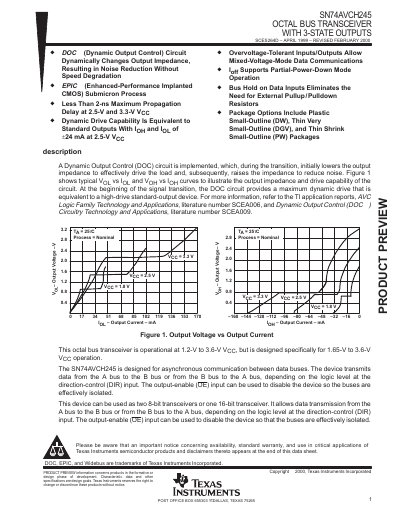
The SN74AVCH245 is an octal bus transceiver designed for asynchronous communication between data buses. It features a Dynamic Output Control (DOC) circuit that reduces noise without degrading speed and supports mixed-voltage-mode data communications with overvoltage-tolerant inputs and outputs.
Key characteristics include Ioff support for partial-power-down mode, active bus-hold circuitry to eliminate external pull-up/pull-down resistors, and operation across a wide supply voltage range from 1.2 V to 3.6 V.
| Supply Voltage Range (Operating) | 1.4 V to 3.6 V |
|---|---|
| Operating Temperature Range | -40 °C to 85°C |
| Maximum Propagation Delay | Less Than 2-ns |
| Control Inputs Leakage Current (VI=0.57V, VCC=1.65V) | ±2.5 mA |
The device operates with a supply voltage (VCC) ranging from 1.4 V to 3.6 V.
Yes, it supports Ioff which disables the outputs to prevent damaging current backflow when powered down.
The maximum propagation delay is less than 2 ns.