
U2044B is a dual output flasher produced by TELEFUNKEN Semiconductors. It uses a dual output circuit to control the left and right sides of the vehicle separately. The chip has an extremely low current consumption and can be directly connected to the battery. It also has temperature and supply voltage compensated flashing frequency, frequency doubling indicates lamp outage and other features.
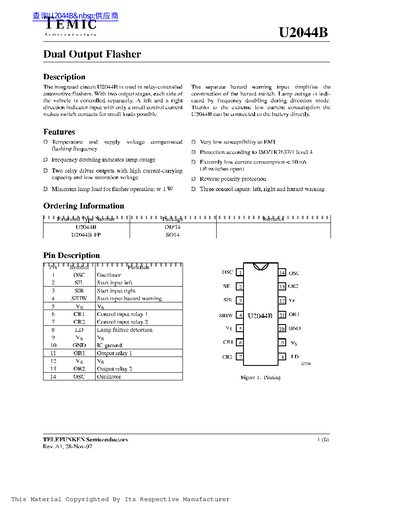
The TEMIC U2044B is an integrated circuit used in relay-controlled automotive flashers. It features two separate outputs to control each side of the vehicle independently and includes a hazard warning input that simplifies switch construction. The device indicates lamp outage by doubling its flashing frequency and operates with extremely low current consumption, allowing direct connection to the battery.
| Supply voltage range | 18 V |
|---|---|
| Supply current (switches open) | < 10 mA |
| Output current for relay driver | 300 mA |
| Junction temperature (Tj) | 150 °C |
| Storage temperature range | -55 to +150 °C |
| Minimum lamp load | 1 W |
The minimum lamp load required for the U2044B to operate as a flasher is 1 Watt.
The U2044B indicates a lamp outage by switching to a frequency doubling mode.
Yes, unlike the direction switches, the hazard input allows activation independent of the ignition switch position.