
Captiva™ NDLipids is a simple to use filtration device designed for the removal of lipids and protein interferences from protein precipitated plasma and serum samples. It effectively reduces phospholipid carry-over in LC/MS-(MS) bioanalysis and eliminates ion suppression, limited analyte sensitivity, and detection caused by lipids eluting during HPLC runs. The use of Captiva NDLipids significantly reduces the need for column and system maintenance and extends the lifetime of the analytical column.
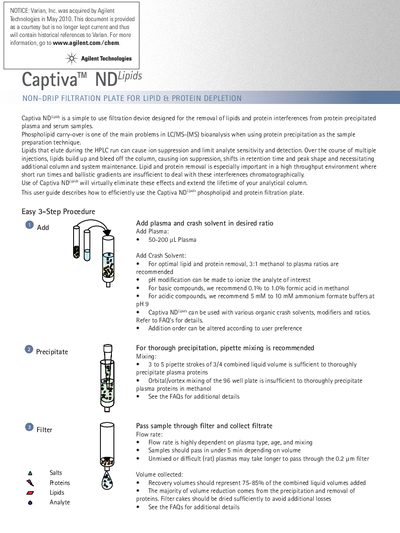
The Agilent Captiva ND is a simple-to-use filtration device designed for the removal of lipid and protein interferences from protein-precipitated plasma and serum samples. It addresses phospholipid carry-over issues common in LC/MS bioanalysis, which can cause ion suppression and limit analyte sensitivity.
Generally, sensitivities obtained from processed samples are better than protein precipitation alone.
Monitor the phosphatidylcholine head group with a 1849184 m/z trace during method development.
Yes, but samples below 50 uL should be pre-diluted with aqueous to maintain the overall organic ratio.
Yes, the non-drip feature allows use in either order, though a single order is recommended for any one assay.