
This document describes the features and characteristics of the 110 HE RELAYS TV-15, 30 AMP (1 Form A) Power Relay VDE, including high contact capacity with superior inrush current characteristics, excellent high heat-resistance, and high dielectric strength.
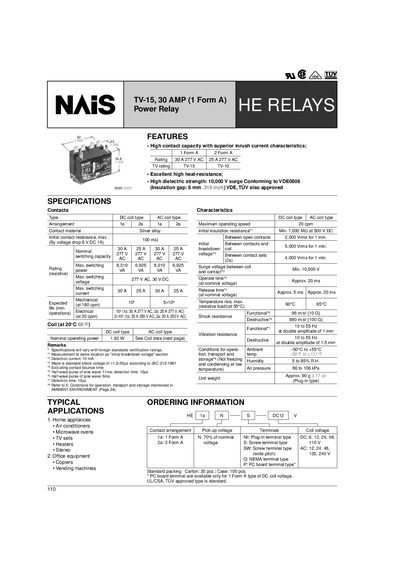
This document provides technical specifications for the HE series of high-capacity power relays manufactured by Matsushita Electric Works. Key features include a maximum switching rating of 30A at 277V AC (TV-15) with superior inrush current characteristics and excellent heat resistance.
The datasheet details various terminal configurations including plug-in, screw, NEMA, and PC board types for both DC and AC coil voltages. It includes comprehensive data on contact arrangements, operating speeds, life expectancy, and ambient temperature limits.
| Maximum Switching Rating (TV-15) | 30A @ 277V AC |
|---|---|
| Dielectric Strength | 10,000 V surge |
| Initial Insulation Resistance | Min. 1,000 MΩ at 500 V DC |
| Maximum Operating Speed | 20 cpm |
| Nominal Coil Power (DC) | 1.92W |
| Unit Weight | Approx. 90 g |
The TV-15 model has a maximum switching rating of 30A at 277V AC.
The maximum operating speed is 20 cycles per minute (cpm).
You need 2 to 4 kg of pulling strength to remove a receptacle.
The optimum fastening torque ranges from 5 kg to 7 kg-cm.