
This document introduces the basic principles and applications of bridge circuits, as well as how to balance gain and balance in bridge circuits. Bridge circuits are basic electrical tools widely used in measurement, switching, oscillator, and transducer circuits, with broadband characteristics ranging from DC to GHz. The document also discusses the basic principles and applications of resistance bridges, as well as techniques to enhance their linearity and sensitivity.
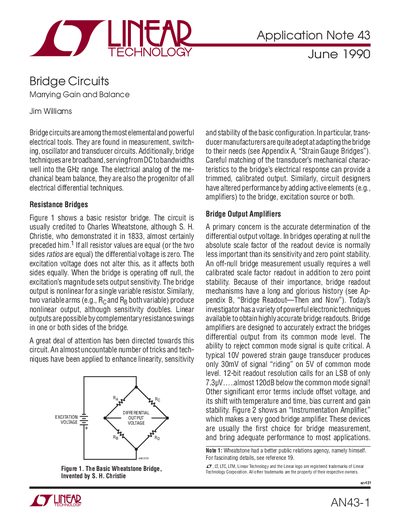
The document introduces the Wheatstone bridge as a fundamental electrical tool used in measurement and oscillator circuits. It discusses resistance bridges, their nonlinear output characteristics when operating off-null, and how complementary resistance swings can achieve linear outputs.
A significant portion of the text covers bridge output amplifiers, specifically instrumentation amplifiers, which are designed to extract differential output voltages from common mode levels. The note details various signal conditioning methods for DC bridge applications, including specific configurations like ratiometric operation and common mode suppression techniques using servo loops.
A typical 10V powered strain gauge transducer produces only 30mV of signal riding on 5V of common mode level.
Instrumentation amplifier A3 extracts the bridge's differential output at a gain of 100.
The LTC1043 supports single or dual power supplies with a maximum of 16V.