
This document introduces the characteristics and features of high-efficiency linear regulators, including efficiency, low noise, and low drift.
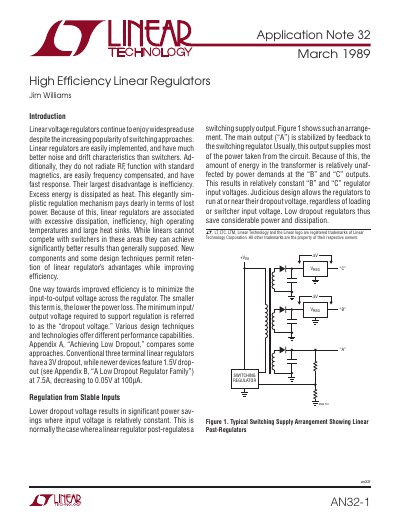
The document explains that while linear regulators offer advantages in noise, drift, and lack of RF radiation compared to switching supplies, their primary disadvantage is inefficiency due to power dissipation as heat. It introduces design techniques to mitigate this issue, specifically focusing on minimizing the input-to-output voltage difference (dropout voltage) across the regulator.
The text details two main approaches for improving efficiency: using low dropout regulators and implementing pre-regulation circuits. For stable inputs, lower dropout voltages significantly reduce power loss. For unstable AC line-derived inputs, the document describes an SCR pre-regulator circuit that stabilizes the input voltage to the linear regulator, maintaining high efficiency even during wide line swings (90VAC to 140VAC). It also covers a DC input pre-regulator using a switched-mode dissipation regulator to maintain the linear regulator's input just above its dropout voltage.
| Conventional three terminal linear regulators dropout voltage | 3V |
|---|---|
| Newer low dropout regulator family dropout voltage at 7.5A | 1.5V |
| Newer low dropout regulator family dropout voltage at 100μA | 0.05V |
Their largest disadvantage is inefficiency, where excess energy is dissipated as heat.
Efficiency can be improved by minimizing the input-to-output voltage across the regulator, specifically by using low dropout regulators.